



Last updated: October 2026
Key Takeaways
- How long a silk pillowcase lasts has no one answer and depends on silk quality, washing method, and frequency of use; silk retailers often report several years for high-quality mulberry silk with proper care, though independent durability studies are not available
- The clearest signs it is time to replace are if the fabric has thinned noticeably, the sheen is permanently gone, or the texture is rough and stiff even after proper washing
- Yellowing on pale silk is caused by oxidized body oils and UV exposure, both of which cause chemical changes in silk's protein structure that are difficult or impossible to fully reverse; prevention is significantly more effective than treatment
- Water or liquid marks on silk involve localized fiber deformation, not just surface residue; some marks may not fully resolve with home treatment
- The copper infusion in a Copper North pillowcase is bonded throughout the fiber matrix through bath immersion, not applied as a surface coating; staining does not indicate the copper has stopped working
How Long Does a Silk Pillowcase Last?
There is no scientific answer to this question. What silk manufacturers and bedding experts consistently report is that a high-quality mulberry silk pillowcase, cared for properly, typically outlasts a standard cotton alternative. The common refrain from silk retailers is that a high-quality silk pillowcase can last anywhere from 2-5 years.
Textile research, however, has not examined this question. Instead, the clearest answer is that the lifespan of a silk pillowcase depends heavily on three factors: the quality of the silk, how it is washed, and how often.
1. SILK QUALITY: In simple terms, higher momme silk is more likely to resist abrasion and physical wear and tear than lower momme silk.
To go a bit deeper, the weight of a silk fabric is measured in momme (~4.34 grams per square meter). Higher momme means more silk fiber per unit area, or fabric weight. In textile engineering, higher fabric weight is associated with greater resistance to abrasion and structural wear than lower weight fabric. In a 2024 peer-reviewed study, a heavier-weight cotton lasted twice as long as a lower-weight cotton that was only 19% less dense (1).
The same principle applies to silk: more fiber mass per unit area means more material available to absorb friction before abrasion occurs. Copper North uses 22-momme silk for this reason, as opposed to common lower weight silk pillowcase options such as 19 momme and under.
2. WASHING METHOD: The main aspects of normal laundering - specifically, hot water, normal detergents, and tumble drying - are the primary causes of premature fiber degradation in silk. Hot water promotes deterioration in silk at the amino acid level, degrading the proteins that give silk its strength and surface texture (2). Standard laundry detergents are alkaline (have a pH above 7), and alkaline conditions accelerate the breakdown of silk fibers, causing a loss of strength and smoothness over repeated washes (3). Common household detergents are also often enzyme-based, or designed to target protein-based stains. These also directly degrade silk fibers, since silk is itself a protein-based fiber (4). Finally, tumble drying combines heat and agitation, both of which degrade silk fiber and cause creasing (5).
The solution is to wash silk in a manner that works with its protein fibers, specifically, washing with cold water, using a silk-safe detergent, and laying flat to try. A pillowcase washed in such a manner will last considerably longer than one washed in hot water, with normal detergents, and/or dried with heat.
3. WASHING FREQUENCY: The final variable in an owner’s control is how often a silk pillowcase is washed, and perhaps, how often it needs to be washed. Silk has natural properties that make it better at resisting soiling than other common bedding materials, like cotton. Silk resists bacteria better than cotton, polyester, wool, and viscose, according to a 2010 study (6). Silk also retains less moisture than cotton, which limits the ability of bacteria to proliferate (7). Whether this translates directly into a reduction in required washing frequency has not been studied in a controlled trial, although there are households that adopt this approach.
Another option to manage washing frequency is to rotate between two pillowcases. If each pillowcase is washed once per week on a 52-week year, rotating between two means each goes through approximately 26 wash cycles annually, roughly half the fiber stress per year.
Five Signs It’s Time to Replace A Silk Pillowcase
Not all imperfections mean it is time to let go. These are the signs that genuinely indicate the silk has reached the end of its useful life:
1. THE FABRIC HAS THINNED NOTICEABLY. Hold the pillowcase up to a light source. If it has become sheer or translucent in the areas where the head rests, typically the center, the fiber density has broken down. This is the most definitive sign of true wear.
2. THE SHEEN IS PERMANENTLY GONE. Silk's characteristic luster and sheen come from its fiber structure, which refracts and diffuses light at multiple angles (8). When this surface structure is compromised by abrasion, heat damage, or chemical exposure (say, from common detergents), the luster cannot be restored. If the pillowcase looks consistently dull and a proper wash does not return any sheen, the fiber surface has likely been permanently altered.
3. THE TEXTURE FEELS ROUGH OR STIFF AFTER WASHING. Stiffness immediately after washing can indicate detergent residue or hard-water mineral buildup, both of which may still be addressable. But if the fabric feels permanently roughened after a thorough, proper wash, the fiber surface has likely been compromised, most commonly by repeated exposure to hot water, harsh chemicals, or friction.
4. THERE ARE SNAGS, PULLS, OR SMALL TEARS. Silk fibers can catch on rough surfaces, jewelry, or other fabrics. Small snags can sometimes be gently pressed back into the fabric, but repeated snagging or visible tears in the weave indicate structural wear.
5. PERSISTENT ODOR THAT WASHING DOES NOT RESOLVE. This indicates deeply embedded oils or bacteria that have degraded the fiber. It is a hygiene signal as much as a wear signal.
How Does a Silk Pillowcase Compare to Cotton in Lifespan?
Cotton sheets are generally replaced at around the 2-year mark, according to the National Sleep Foundation's bedding survey as cited in NBC News, which noted that "most people will replace them within two years" (9). Good Housekeeping confirms the same rough timeline recommending replacement every 2-3 years, while being on the watch for “thinning, stubborn staining, or loss of softness” as early indicators (10). Considering the fact that we spend more time on our sheets than any item of clothing in a year, this starts to seem like a reasonable timeline.
The comparison to silk is harder to make with equivalent source quality. What textile science does confirm is that silk's continuous filament structure - distinct from cotton's shorter, twisted staple fibers - produces a smoother, more friction-resistant surface (11). The structural properties that give silk its luster and low friction coefficient also contribute to its resistance to surface abrasion. How that translates to a specific number of years of usable life is an estimate, not a measured benchmark.
The practical framing: if cotton pillowcases show signs of wear at 1-2 years despite standard care, a well-maintained silk pillowcase at 22-momme, with its longer fibers and smoother structure, is unlikely to show equivalent wear at the same point, provided proper care is observed and degradation risks are avoided (e.g., hot water, enzymes, mechanical friction).
How to Wash a Silk Pillowcase
Carolyn Forte, Director of the Home Care and Cleaning Lab at the Good Housekeeping Institute, recommends washing silk pillowcases as frequently as cotton ones: once per week (12). The difference is in how, not how often.
HAND WASHING (PREFERRED): Fill a basin with cool water and add one teaspoon of gentle laundry detergent to one gallon of water. If there are visible stains, apply a few drops of detergent directly to the stain and gently work in with fingertips. Submerge the pillowcase and swish gently. Do not twist, wring, or rub the fabric against itself. Rinse thoroughly until residue is gone. Gently squeeze out excess water, roll in a clean white towel to blot, then lay flat to dry away from direct sunlight.
MACHINE WASHING: Place the pillowcase inside a mesh laundry bag. Select the delicate cycle with cold water and a gentle, silk-safe detergent. If the machine has a center agitator, use caution as it can damage delicate fibers. Do not tumble dry, as heat can degrade the fibers (5). Rather, lay flat to dry.
WHAT TO AVOID: Enzyme-based detergents, which are common in most standard laundry products, are designed to break down protein-based stains. Silk is a protein-based fiber, and repeated exposure to enzyme detergents degrades the fiber over time (4). Do not use bleach, as it will break and discolor the fibers (12). Always use a detergent specifically formulated for silk or delicates. Copper North sells Soak, a no-rinse, pH neutral detergent that is gentle enough for repeated use on silk without compromising the fiber or the copper infusion.
For a step-by-step guide, see our dedicated article: How to Wash a Silk Pillowcase.
Why Does A Pillowcase Turn Yellow, and Can It Be Fixed?
Yellowing is a question we hear often, and the honest answer is more nuanced than most care guides suggest. All pillowcases, regardless of fiber, have two common sources of yellowing. Silk, as a protein-based fiber, has one additional possible source of yellowing that is chemically distinct.
Body oils and sweat
Cotton, silk, and polyblend pillowcases are all susceptible to yellowing from skin oil. Skin oils (sebum) and sweat deposited on pillowcases during sleep oxidize when exposed to air. A review published in the Journal of Surfactants and Detergents found that oily soil yellowing in textiles is caused by the oxidation of unsaturated lipids, and that as oily soils age in fabric, they become progressively harder to remove due to oxidation, wicking deeper into fiber capillaries, and possible chemical bonding between oxidized oils and the fiber proteins themselves (13). This means the longer the yellowing has been developing, the less likely washing alone is to reverse it.
Haircare or Skincare Products
Similarly, all pillowcases are subject to possible staining and yellowing from haircare or skincare products that seep into fibers overnight. Popular treatments, like topical minoxidil for hair loss (Rogaine is a common brand name), can stain clothing and bed linens if not completely dry before coming into contact with the textile (14). Once stained, as with skin oil-based stains, these soils become particularly hard to remove.
Ultraviolet Light
Unique to pillowcases made of silk, sunlight can play a role in yellowing as well. Research published in 2021 found that exposure to ultraviolet (UV) light caused measurable yellowing of silk fibers, which was the result of a chemical change in the fiber (15). This UV exposure caused permanent yellowing as it was due to a chemical change to the fiber itself, not a surface stain that washing can remove.
The Hard Truth About Established Pillowcase Yellowing
Once oxidative yellowing has set into the fiber, whether from body oils or light exposure, it represents a chemical change to silk's protein structure that is difficult or impossible to fully reverse with home washing methods. Prevention is significantly more effective than treatment. Another choice some make is to invest in darker color silk, which is less likely to show stains and yellowing than paler colors.
WHAT MAY HELP WITH EARLY OR MILD YELLOWING: For yellowing that is recent and mild, more frequent washing with a pH-neutral silk-safe detergent in cool water may slow or partially reduce the discoloration. Soaking for 10 to 15 minutes before gently agitating can help loosen oils before they have fully oxidized (12). This is most effective as early intervention, not as a remedy for established yellowing.
WHAT NOT TO DO: Bleach is not an option. Chlorine bleach attacks silk's protein structure and will permanently damage the fiber (12).
Does yellowing mean it is time to replace?
This depends on how far the yellowing has progressed. A pale pillowcase with early yellowing that has not yet set deeply may still be addressable with proper care. Established yellowing on ivory or pink silk that has persisted through multiple proper washes is likely a permanent chemical change. Combined with other signs of wear, such as thinning, roughness, persistent odor, it is a signal to replace. A pillowcase that has yellowed but remains smooth, flexible, and otherwise intact may still be performing its function even if it no longer looks pristine.
Water Marks and Liquid Stains: Why They Happen
Water marks on silk are more persistent than many care guides suggest, and understanding why helps set realistic expectations.
When a wet area of silk dries unevenly, two things can happen. First, dissolved minerals and residue are carried toward the edges of the wet area as the water evaporates, concentrating there as the fabric dries (16). Second, the silk fibers themselves can deform locally when wet and reset in a slightly different configuration than the surrounding dry fibers, a process confirmed in peer-reviewed research on silk fiber mechanics (17). The result is a visible mark at the liquid's edge, even after the moisture itself is gone. This fiber deformation is distinct from surface residue and is harder to address.
Hard water may also amplify the mineral deposit problem. Hard water has higher concentrations of calcium. Textile research shows that repeated exposure to calcium-rich solutions can alter silk fibers’ structure and increase fabric stiffness (18), in some cases leaving a ring that can be seen.
WHAT MAY HELP: Re-wetting the entire pillowcase in cool, distilled water and drying it flat and evenly may address the residue migration issue by redistributing rather than concentrating deposits. For mineral deposits specifically, a brief rinse with a very dilute white vinegar solution (one part vinegar to four parts distilled water) can dissolve calcium and magnesium deposits. Rinse thoroughly afterward with distilled water if possible and dry flat. This should be an occasional treatment, not a routine one, and done quickly, as prolonged exposure to this acidic solution can damage silk’s fibers in new ways. Acting quickly on any liquid mark significantly improves the chances of resolution.
WHAT MAY NOT HELP: If the mark involves fiber deformation rather than surface residue, particularly in marks that have dried and reset through multiple wash cycles, it may not fully resolve with home treatment. Good Housekeeping advises taking a stained silk item to a professional cleaner if stains persist after proper home treatment attempts rather than continuing to apply home remedies that may further stress the fiber (12).
For liquid stains other than water: Act quickly. Good Housekeeping recommends applying a small amount of mild detergent directly to the stain, working it in gently with fingertips, allowing it to sit for 10 to 15 minutes, and then washing the whole pillowcase (12). Oil-based stains that have dried and set are significantly harder to remove.
Is the Copper Still Active If the Silk Pillowcase Is Stained?
Yes, and the reason is important.
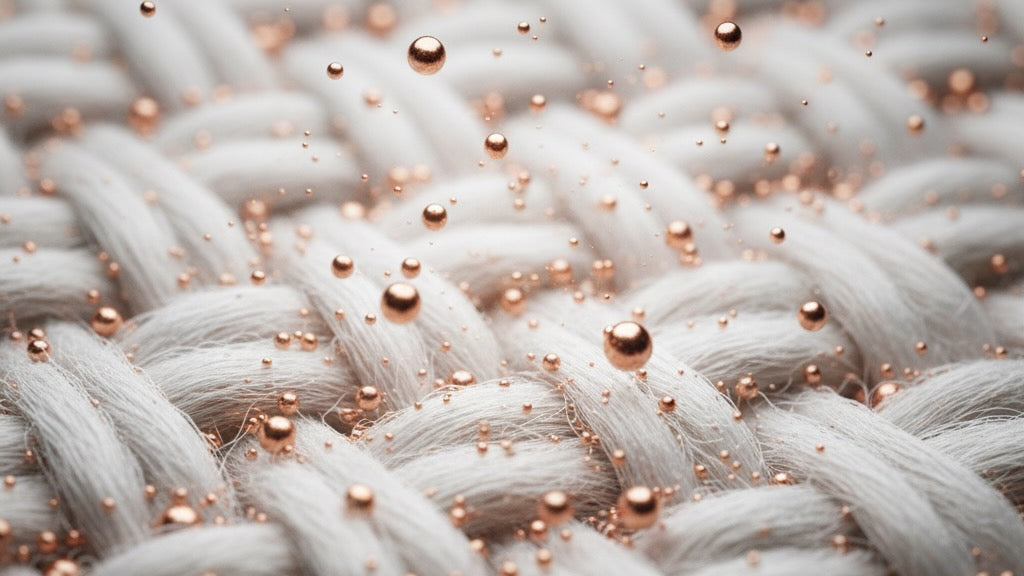
Copper North's silk is infused through a bath immersion process that bonds copper ions throughout the entire fiber matrix, not applied as a surface coating. This is covered in detail in our article How Copper Infused Fabric Works. Because the copper is distributed through the fiber itself rather than sitting on top of it, surface staining, whether from body oils, skincare products, or water marks, does not affect the copper infusion or reduce its properties.
Our finished fabrics are independently tested before going to market to confirm copper is present and evenly distributed throughout the fiber. That distribution is not affected by what accumulates on the surface during use.
What can affect the copper infusion over time is the same thing that affects the silk fiber itself: exposure to harsh chemicals, bleach, or enzyme-based detergents. Caring for the silk correctly protects both the fiber and the copper infusion simultaneously.
Frequently Asked Questions
How often should I wash a silk pillowcase?
Once per week, the same frequency recommended for cotton pillowcases, according to Carolyn Forte, Director of the Home Care and Cleaning Lab at the Good Housekeeping Institute (12). Regular washing is also the most effective prevention against oxidative yellowing, removing oils before they oxidize into the fiber is far more effective than treating established yellowing afterward.
Can I machine wash a silk pillowcase?
Yes, if the care label permits it. Place in a mesh laundry bag, select cold water on the delicate cycle, use a silk-safe detergent, and lay flat to dry rather than tumble drying (12). Hand washing is gentler and extends the lifespan of the fiber over many wash cycles.
Why does a silk pillowcase feel stiff after washing?
Stiffness after washing is often due to detergent residue or hard-water mineral buildup. A thorough rinse in cool distilled water, or an occasional rinse with a very dilute white vinegar solution followed by a thorough rinse, may help dissolve mineral deposits. If stiffness persists after a proper re-wash, the fiber may have been exposed to hot water or harsh chemicals at some point, which can cause more permanent changes to the surface texture (2, 3).
Is yellowing a sign I need to replace the pillowcase?
It depends on how established the yellowing is and whether the fabric is otherwise intact. Early, mild yellowing may respond to more frequent washing with a pH-neutral silk detergent. Established yellowing that has persisted through multiple proper washes is likely a permanent chemical change to the fiber protein (13, 15). If yellowing is accompanied by thinning fabric, persistent odor, or texture that washing does not restore, that combination points clearly toward replacement.
How does silk compare to cotton for longevity?
Laundry and bedding experts generally recommend replacing cotton sheets at around 2 years (9, 10). High-quality silk at 22-momme has structural properties, like a denser weave and a smooth continuous filament surface, associated with greater resistance to surface abrasion and wear (1). Independent long-term durability studies comparing silk and cotton pillowcase lifespans have not been published. The comparison is supported by textile science on fiber structure rather than a controlled lifespan study.
Does staining affect the copper infusion?
No. Copper North's copper infusion is bonded throughout the fiber matrix through a bath immersion process, not applied as a surface coating. Surface staining does not reduce or eliminate the copper content. Caring properly for the silk by avoiding bleach, enzyme detergents, and hot water, among other steps, protects both the fiber and the copper infusion simultaneously (4, 5).
Read More From Copper North
The Art:
The Science:
- The Best Pillowcase for Sensitive Skin: What Dermatology Research Shows
- Does Copper Help With Acne? What Peer-Reviewed Research Shows
- How Copper Infused Fabric Works: The Process Behind Copper-Infused Silk
- Dust Mites in Pillows: What You Should Know
- Silk vs. Cotton Bedding: A Science-Backed Guide
References
- Posso-Pasquel J., et al. (2024). "Comparative Study of Abrasion Resistance in Cotton and Meta-Aramid Fabrics for the Production of Safety Garments." Emerging Research in Intelligent Systems, Lecture Notes in Networks and Systems, vol. 903. Springer Link
- Van Amber, RR; Niven, BE; Wilson, CA (2010). “Effects of laundering and water temperature on the properties of silk and silk-blend knitted fabrics.” Deakin University. Journal contribution. Link
- Ovi FI and Islam MM. (2026). “Systematic optimization of alkali treatment parameters for sustainable textile processing: Comparative performance, energy efficiency, and environmental assessment across natural and synthetic fiber systems.” Next Research. 10:101881. Link
- Schroeder M, et al. (2006) “Restricting detergent protease action to surface of protein fibres by chemical modification.” Applied Microbiology and Biotechnology. 72(4):738-44. Link
- Ma, M, et al. (2014). “Effects of ultrasonic laundering on the properties of silk fabrics.” Textile Research Journal. 84(20):2166-2174. Link
- Varshney S, et al. (2021). "Factors Affecting Bacterial Adhesion on Selected Textile Fibres." Indian Journal of Microbiology. Link
- Parlin, A., et al. (2020). "A Laboratory-Based Study Examining The Properties Of Silk Fabric To Evaluate Its Potential As A Protective Barrier For Personal Protective Equipment And As A Functional Material For Face Coverings During The Covid-19 Pandemic." PLoS One. 15(9):e0239531. Link
- Hu, F. et al. (2020). "Interplay between Light and Functionalized Silk Fibroin and Applications." iScience. 23(4):101098. Link
- NBC News. (2018). "Here's How Often You Should Replace Everything in Your Bedroom." Citing a National Sleep Foundation poll. Accessed Sep 28, 2026. Link
- Duggan, E. (2025). “Your bedsheets have an expiry date - here’s when it is and why you should stick to it.” Good Housekeeping. Accessed Sep 28, 2026. Link
- TRI Princeton. (2025). "Everyone is Talking About: Silk Pillowcases." TRI Academy. Link
- Bailey, A and Ballard, J. (Updated 2026). “Laundry Experts Reveal the Safest Way to Wash Silk Pillowcases.” Good Housekeeping. Accessed Sep 28, 2026. Link
- Chi, Y. and Obendorf, S.K. (1998). "Aging of oily soil on textiles: a literature review." Journal of Surfactants and Detergents. 1(3): 407–418. Link
- Mayo Clinic. “Minoxidil (Topical Route).” Drugs & Supplements. Accessed Sep 25, 2026. Link
- Lee, S et al. (2021). "Effects of Ultraviolet Light Irradiation on Silk Fibroin Films Prepared under Different Conditions." Biomolecules. 11(1):70. PMC7825685. Link
- Duprat, C. et al. (2022). "Moisture in Textiles." Annual Review of Fluid Mechanics. 54:443–467. Link
- Podbevšek D, et al. (2024). "The role of water mobility on water-responsive actuation of silk." Nature Communications. 15. Link
- Park SZ, et al. (2010). “Effect of the Calcium Nitrate Solution Treatment on the Tensile, Bending, and Shear Properties of Silk Fabric”. Fashion Business. 14(6). Link





Share: